Showing posts with label George Wythe. Show all posts

Wednesday, July 4, 2018

Happy Independence Day!


To honor Independence Day, here are some reminders, from the campus of the College of William and Mary, of our nation's struggle for independence. 


   Wrote The Declaration


Hero of the Battle of Trenton


Captain in the Continental Army (left)
Thomas Jefferson's Teacher. Signed Jefferson's Most Famous Work (right)


Memorial to the French Soldiers Who Died in the Siege of Yorktown

Tuesday, January 10, 2017

Statues in the Snow, William and Mary 2017


Thomas Jefferson


John Marshall and George Wythe


Lord Botetourt


James Monroe


James Blair

Sunday, December 6, 2015

Happy Birthday to the 13th Amendment!


Dreamed of Abolition


Ditto


Made it Happen

Today is the 150th anniversary of the ratification of the 13th Amendment, which banned slavery and indentured servitude.  The Senate passed the Amendment on April 8, 1864, and the House of Representatives followed suit on January 31, 1865 after determined lobbying by President Lincoln and his administration.   Georgia ratified the Amendment on December 6, 1865, thereby providing the requisite three fourths of the states necessary to amend the Constitution.

Here is the text of the Amendment, in its entirety. 

Section 1

Neither slavery nor involuntary servitude, except as a punishment for crime whereof the party shall have been duly convicted, shall exist in the United States, or any place subject to their jurisdiction.

Section 2

Congress shall have power to enforce this article by appropriate legislation.

The Amendment implemented the abolitionist vision that George Wythe and St. George Tucker, both pictured above, had articulated more than half a century earlier.    Wythe, of course, occupied the Chair of Law and Police at William and Mary beginning in 1779 and was thus the nation's first law professor.  Wythe endorsed abolition and freed his own slaves.  As a judge on Virginia's Chancery Court, he announced in Hudgins v. Wright (1806) that the Virginia Declaration of Rights provided that all persons are free, regardless of race.    Tucker, one of Wythe's students, succeeded his teacher as William and Mary's second Chair of Law and Police in 1790 and echoed Wythe opposition to human bondage.  In 1796, Tucker authored a 116 page pamphlet addressed to the state legislature and entitled "A Dissertation on Slavery, With a Proposal for the Gradual Abolition of It, in the State of Virginia."  

Unfortunately the Virginia Legislature did not embrace Tucker's proposal, and an appellate court reversed Wythe's decision in Hudgins.  Instead, and tragically, it took the Civil War to end slavery.  During that war, Abraham Lincoln explained what was at stake in an April, 1864 speech.

"The World has never had a good definition of the word liberty, and the American people, just now, are much in want of one. We call declare for liberty; but in using the same word we do not all mean the same thing.  With some the word liberty may mean for each man to do as he pleases with himself, and the product of his labor; while with others the same word may mean for some men to do as they please with other men, and the product of other men's labor.  Here are two, not only different, but incompatible things, called by the same name --- liberty.  And it follows that each of the things is, by the respective parties, called by two different and incompatible names --- liberty and tyranny."

Lincoln, of course, embraced the first definition, namely that "liberty" includes the right of each person to do as he or she pleases with himself or herself and with the product of his or her labor.  The Thirteenth Amendment finally made this definition a reality, at least as a matter of Constitutional Law, for all Americans.  If Virginia and the rest of the Nation had listened to Tucker and/or Wythe in 1796, 1806 or some time in between, America could have extended the blessings of liberty to all persons much sooner, eradiacted the evil of human bondage and avoided the cataclysm of civil war.

Tuesday, January 20, 2015

Sunday, July 3, 2011

Another Founding Father For Abolition

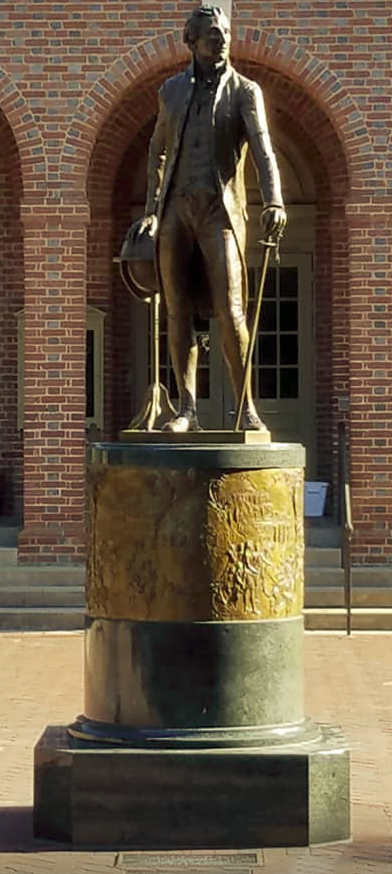
American Aristides and Abolitionist


The Economist magazine has waded into the controversy, born as a dispute between ABC's George Stephanopolous and presidential candidate Michele Bachmann, over the extent to which the American Founders worked to end slavery. As many know, Stephanopolous argued that the Founders did not work to end slavery, while Congresswoman Bachmann claimed they did, citing only John Quincy Adams, a young boy at the time of the Revolution, as an example.

In a piece entitled "John Jay Saves the Day," The Economist has offered some support for Congresswoman Bachmann's assertion, contending that: "[p]lenty of founders did fight hard to end slavery." At the same time, the essay asserts that "the really good guys on slavery were not" Washington, Jefferson and Madison, but instead "less venerated big government Yankee founders who sped the abolition of slavery in the North." As examples, the essay cites Alexander Hamilton and John Jay of New York and Gouverneur Morris of New Jersey. The piece praises Jay, himself a slave owner, for purchasing slaves and then granting them freedom after what Jay deemed a reasonable period of time. The piece also praises Jay for signing a 1799 New York "Act for the Gradual Abolition of Slavery." The Act provided that, beginning on July 4 of that year, all children born to slave parents in New York would be free. The Act also prohibited the export of slaves from New York.


The Economist is certainly right to praise Jay, Hamilton, and Morris for their opposition to slavery and their efforts to combat it. Hopefully Congresswoman Bachmann and George Stephanopolous will "stand corrected" and give these gentlemen their due. However, the Economist errs when it suggests that only northern Founders fought to end slavery, failing, as it does to mention George Wythe of Virginia, a prominent Founder and Abolitionist.

Wythe is perhaps best known as the first Professor of Law and Police ("policy") at the William and Mary Law School, founded as the nation's first law school in 1779. (Wythe served in this capacity until he resigned in 1789.) Less well-known is his role in the American Independence Movement and adoption of the U.S. Constitution. He drafted the Virginia Legislature's Resolution in Remonstrance, protesting the Stamp Act, in 1764. Elected to the Continental Congress in 1775, Wythe voted for the Resolution of Independence, moved by fellow Virginian Richard Henry Lee, and signed the Declaration of Independence drafted by Jefferson. He then served as Speaker of Virginia's House of Delegates from 1777-78. He was a member of the Virginia Court of Chancery for more than two decades. In the so-called "Case of the Prisoners" (Commonwealth v. Caton, 1782) Wythe issued an opinion claiming the power to invalidate unconstitutional statutes, thereby presaging the doctrine of judicial review articulated by his student, John Marshall, in Marbury v. Madison, 5 U.S. 137 (1803).

Wythe also attended the Philadelphia Convention that drafted and proposed the U.S. Constitution. George Washington, who presided, appointed Wythe, along with Hamilton and Charles Pickney, to a committee charged with developing procedures to govern the Convention. However, he left the convention early and did not sign the document. He did, however, participate as an elected member of the Virginia Convention that voted to ratify the proposed Constitution.


Like the northern Founders extolled by the Economist, Wythe was an abolitionist. He freed his own slaves and provided for their support, teaching Ancient Greek to one former slave who continued to live with Wythe in Richmond. Moreover, as a Judge in the District Court of Chancery in Richmond, Wythe ruled that the Virginia Declaration of Rights created a presumption that all men were free, regardless of their race. (Unfortunately, an appellate court reversed this portion of Wythe's opinion.) No doubt Wythe's example helped inspire the other Virginians who freed their slaves in the post-Revolutionary period. Perhaps Wythe's example also inspired his successor at William and Mary, St. George Tucker, to craft his "Plan for the Gradual Abolition of Slavery" published in the mid-1790s.


It is little wonder that Wythe's biographer called him the "American Aristides," a reference to the Athenian leader whose moderate assessment of tribute owed by members of the Delian League helped earn him the title of "the Just."

Hopefully the Economist, George Stephanopolous and Congresswoman Bachmann will "correct the record" and recognize Wythe's role in helping eradicate human slavery in the United States. July 4th would be a perfect day to start!